
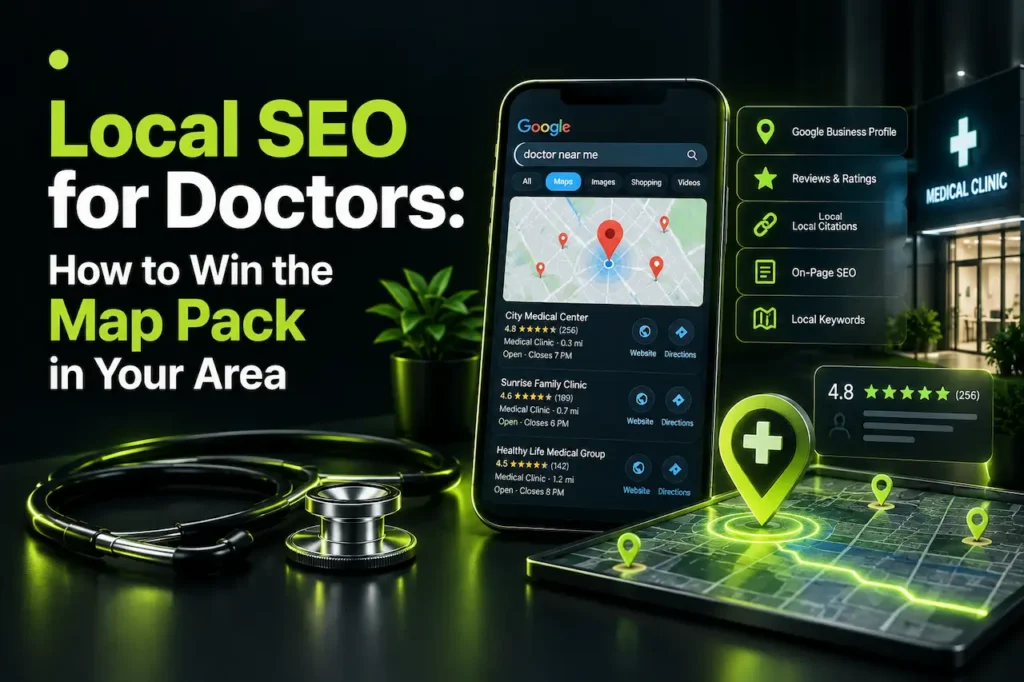
Three practices appear in the map pack. Everyone else is invisible. That is the entire competition, and most practices lose it before they start.
We have audited hundreds of medical sites, and the pattern is consistent. Local SEO for doctors is not won by whoever spends most. It is won by whoever fixes the boring things first, in the right order, and keeps them fixed.
What Local SEO for Doctors Actually Controls
Google ranks local results on three inputs: relevance, distance, and prominence. Relevance is how well your profile matches the search. Distance is how far you sit from the searcher. Prominence is how well known your practice appears across the web.
You control two of those three completely and the third not at all.
That split matters more than any tactic. Effective local SEO for doctors means pouring effort into relevance and prominence, because distance is fixed the day you sign your lease. Practices that misunderstand this spend years chasing rankings in neighborhoods they were never going to serve.
The work divides into four assets: your business profile, your location and provider pages, your reviews, and your citations across professional directories. Everything else is secondary.
The Proximity Ceiling Nobody Explains
Here is the part most agencies avoid saying. In dense metros, map pack results change every few blocks. A patient searching from two miles away sees a completely different set of three practices than a patient searching from your parking lot.
This means there is a hard ceiling on how far your map visibility extends, and no budget removes it. A practice in a major US metro might realistically dominate a two to three mile radius. In a smaller city with fewer competitors, that radius can stretch to eight or ten miles.
So the honest strategy splits in two. Inside your radius, you compete for the map pack, and profile work drives it. Outside your radius, the map pack is closed to you, and organic page rankings are the only route in. That is where treatment and condition pages earn their keep, because those results are far less distance sensitive.
Any provider who promises map pack rankings across an entire metro either does not understand this or is counting on you not to. This distinction sits at the center of how we structure every SEO for doctors engagement.
Your Business Profile Is the Highest Return Work Available
Nothing else in local SEO for doctors returns as fast per hour spent. Most practices we audit have a profile that is sixty percent complete and has not been touched in two years.
Categories decide what you compete for
Your primary category is the single most powerful field on the profile. It determines which searches you are eligible to appear for at all.
Choose the most specific category that truthfully describes the practice. A dermatologist should select Dermatologist, not Doctor. A practice that lists Doctor as primary is competing against every physician in the area for nothing in particular. Add secondary categories only where they describe services you genuinely deliver.
Name, address, and hours must match reality
Use the name on your signage. Nothing more. Adding a city or specialty to the profile name violates the rules and puts the listing at risk of suspension, which costs far more than the temporary lift it produces.
Hours need special hours added for holidays. A patient who drives to a closed office leaves a one star review, and that costs more than the missed visit.
Photos and services are underused
Upload at least fifteen current images covering the exterior, reception, treatment rooms, and team. The exterior shot matters most, because it helps a first time patient find the door.
Fill out the services list completely with real descriptions rather than single words. This is one of the few places where you can add treatment language directly into the profile without violating anything.
We cover the full profile setup in detail in our guide to why a clinic misses Google Maps placement.
Which Providers Should Have Their Own Profile
This question causes more damage than any other in local SEO for doctors, because practices either create too many profiles or none at all.
The rule is simpler than it looks. A provider qualifies for their own profile when three things are true: they are public facing, they have their own patient base, and patients can contact them directly at the verified location during stated hours.
Under that rule, an employed surgeon who sees their own patients qualifies. A nurse practitioner supporting a physician usually does not. Front desk and administrative staff never do.
The organization keeps its own profile alongside eligible provider profiles. That is allowed and it is the correct structure for a multi provider group. What is not allowed is one physician creating separate profiles for each specialty they practice, or a practice creating department profiles that are really keyword targets in disguise.
We always advise clients to document this structure before touching anything. Merging or removing duplicate profiles later is slow and messy. Getting it right early is a standard first step in our medical practice SEO process.
Location and Provider Pages That Actually Convert
A profile gets you seen. The page it links to decides whether the patient calls. Most practices link every profile to their homepage, which wastes the click entirely.
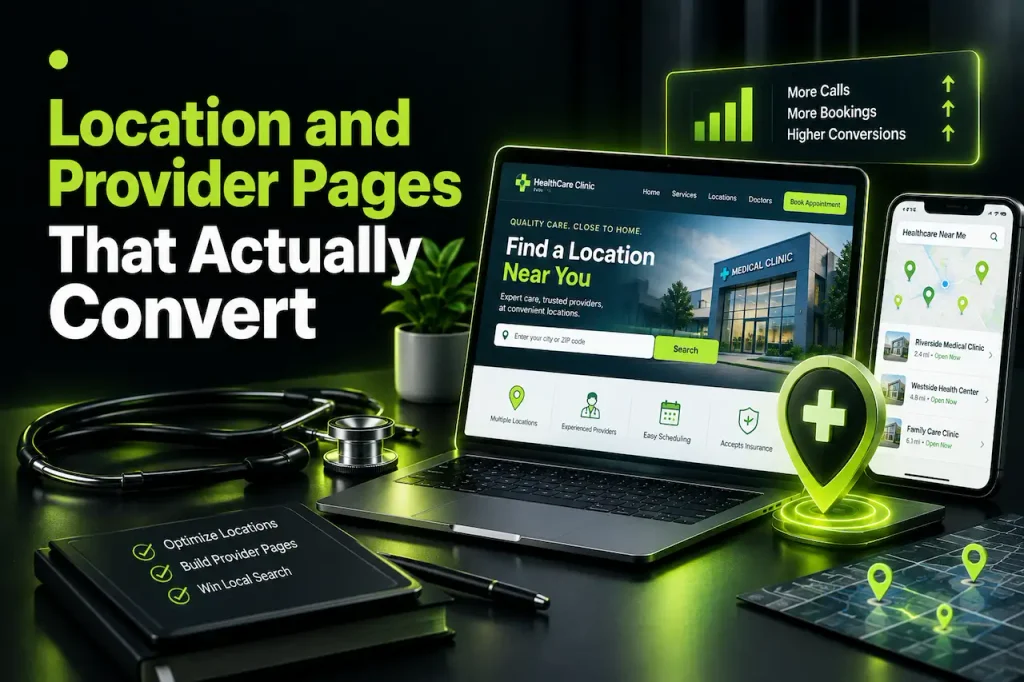
Every physical location needs its own page containing:
- The exact name, address, local phone number, and hours matching the profile precisely
- Directions, parking details, nearest transit, and accessibility information
- Which providers practice at that location and which services are available there
- An embedded map and a photograph of the building exterior
- Insurance accepted, and what a patient should do for urgent care outside hours
- One clear appointment path that works on a phone in two taps
Provider pages need credentials, board certifications, conditions treated, locations served, and a plain language biography. These pages rank for name searches after referrals, which is some of the highest intent traffic a practice ever receives.
Never publish city pages for locations where you have no office. Thin geographic pages are the fastest route to a site wide quality problem. Pages built on a weak foundation also underperform regardless of content, which is why we usually pair this work with healthcare website design improvements.
Reviews Without Creating a Privacy Problem
Reviews feed prominence, and prominence is one of the two levers you control. But healthcare review collection carries risk that other industries never face.
Ask every eligible patient at the same point in the visit journey. Same timing, same wording, no exceptions. Selecting only the patients you expect to leave five stars is review gating and it violates platform policy.
Never offer discounts, gifts, or priority scheduling in exchange for a review. Tell patients plainly not to include health details in what they write.
Replies carry the bigger risk. Do not confirm that the reviewer was a patient. Do not mention an appointment, a treatment, a bill, or a clinician by name, even when the reviewer raised it first. A short thank you for positive reviews and an invitation to continue privately for negative ones is the correct pattern every time.
Steady growth beats volume spikes. A practice at 4.6 stars across ninety reviews reads as more credible than a perfect five across twelve. Credibility signals like these connect directly to the standards covered in our guide to EEAT for healthcare content.
The Mistakes We Fix Most Often
These are the issues we find on nearly every audit we run for practices across the United States.
- Profile linked to the homepage. Every location profile should point to its own location page, not the front door of the site.
- Inconsistent phone numbers. A tracking number on the profile and a different number on the website breaks the consistency signal that local ranking depends on.
- Categories set once and forgotten. Practices add services over years and never update the profile to match.
- Duplicate provider profiles. Physicians who moved practices often leave an unclaimed profile at the old address, splitting their authority.
- No location page at all. Multi location groups with one contact page listing four addresses will not rank any of them properly.
- Reviews with no replies. Unanswered reviews signal an inactive practice to both patients and the ranking systems.
- Broken appointment paths. We regularly find forms that have not sent an email in months, which turns every ranking gain into a lost patient.
Fix these seven before spending on anything new. The full sequencing logic behind that order is laid out in our healthcare SEO guide.
A Pattern We See Repeatedly
Here is a scenario Care Digital Experts encounters regularly. A four provider orthopedic group ranks nowhere in the map pack despite being the largest practice in their submarket. They have strong reviews and a modern site.
The audit finds three problems in twenty minutes. The primary category is set to Doctor rather than Orthopedic Surgeon. All four physicians share the organization profile with no individual profiles despite each holding their own patient panel. And the profile links to the homepage, which mentions no address at all.
Our fix in cases like this is to change the primary category, build eligible provider profiles for each physician, create a proper location page, and point every profile at the correct destination. Total working time is usually under three weeks.
Practices in this position often enter the map pack for their core specialty term inside the first month and begin ranking for individual physician name searches shortly after. Nothing about their reputation or their website design changes. The signals were simply pointing at the wrong things.
Local SEO for doctors rewards accuracy far more than effort.
A 90 Day Sequence That Works
Order matters as much as activity. This is the sequence we run.
Days one to fifteen go to audit and repair. Claim and verify every profile, correct categories, fix name and address and hours, remove duplicates, and confirm the appointment path works on mobile.
Days sixteen to forty five go to structure. Build the location page for each site, build provider pages for each eligible physician, connect every profile to its correct page, and implement medical practice structured data.
Days forty six to ninety go to signals. Correct the professional directories that already list you, start the review request process, publish the first treatment pages targeting terms outside your map radius, and set up call and form tracking by page.
Only after day ninety does ongoing content work earn its cost. Practices that start with blogging before fixing the profile are paying for reach they cannot yet convert. Budget expectations for each stage are covered in our breakdown of medical SEO cost.
How to Measure Local SEO for Doctors
Rank tracking alone will mislead you, because local results shift by street corner. Measure actions instead.
Track profile calls, direction requests, and website clicks month over month from the profile dashboard. Track form submissions and calls separately for each location page. Then track the only number that matters, which is new patient appointments booked and attended from organic sources.
Run the same set of five searches monthly from the same location and device, and record the date. Consistency in how you check matters more than the tool you use.
If profile views rise but calls do not, the problem is your listing content or your reviews. If calls rise but appointments do not, the problem is at your front desk, not in search. Dental practices tracking the same metrics can compare approaches on our dental SEO page.
Conclusion
Local SEO for doctors comes down to four assets: an accurate profile, real location and provider pages, honest reviews, and consistent directory listings. Fix the profile first, because it returns fastest. Accept the proximity ceiling and use treatment pages to reach patients beyond it. Measure appointments, not rankings. Ninety days of correct sequencing beats a year of scattered activity.
Why Choose Us
Care Digital Experts builds local search programs for medical practices only, so profile eligibility, privacy safe review handling, and compliant page structure are already built into how we work.
- We audit profile structure and provider eligibility before touching anything, so nothing gets suspended later
- We build dedicated location and provider pages rather than pointing every profile at a homepage
- We set up privacy safe review collection and reply templates your front desk can actually use
- We track calls and form submissions by page, so you can see which location is producing patients
- We work with medical, dental, and aesthetic practices across the United States using white hat methods only
Want to know why your practice is missing the map pack? Book a free consultation and we will audit your profile structure at no cost.
Frequently Asked Questions
How long does local SEO take to work for a medical practice?
Profile corrections often show movement within two to six weeks because the changes are structural rather than content based. Broader ranking gains for treatment terms typically take four to six months.
Should every doctor in my practice have their own Google profile?
Only providers who are public facing, hold their own patient base, and can be contacted directly at the verified location during stated hours. Support staff and administrative team members should never have individual profiles.
Can I rank in the map pack across my whole city?
Not usually. Map results are heavily distance based, so visibility typically extends two to three miles in dense metros and further in smaller markets. Reaching patients beyond that radius requires organic treatment and condition pages instead.
Is it against the rules to ask patients for reviews?
Asking is allowed when the request is neutral, offered to every eligible patient at the same point, and carries no incentive. Sending only satisfied patients to a public review link is review gating and violates policy.
Do I need a separate page for each office location?
Yes. A single contact page listing several addresses will not rank any of them well, and each profile should link to a page describing that exact location, its providers, and its services.