
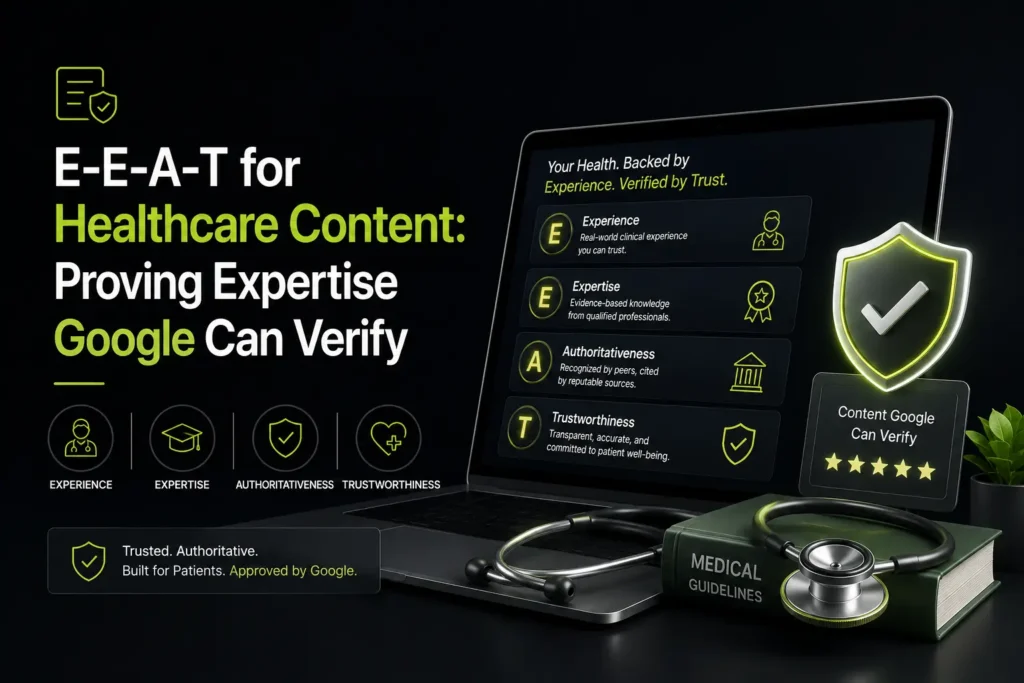
E-E-A-T healthcare content requires a named author or reviewer with verifiable clinical credentials, citations to primary medical sources, visible review dates, and a published editorial process. Health content sits in Google’s highest-scrutiny category, where these function as prerequisites rather than improvements.
Your content is well written, well optimized, and invisible. That is usually not a keyword problem. This article covers what Google’s quality systems actually look for on medical pages, and what a small practice can realistically build.
What YMYL means for your site
Your Money or Your Life is Google’s classification for content that could affect someone’s health, safety, or finances. Medical content is the central example, which means every clinical page you publish is graded against a higher bar than a page on your parking arrangements.

The practical consequence is straightforward. Pages missing author credentials or clinical review are systematically downweighted, regardless of how well they are otherwise optimized.
The four dimensions, in practical terms
- Experience. First-hand involvement. For a practice, this means describing what you actually do, your process, your typical timelines, what patients usually ask.
- Expertise. Formal credentials in the subject. A writer covering a condition is not expertise; a clinician who treats it is.
- Authoritativeness. External recognition. Board certifications, hospital affiliations, specialty society membership, directory profiles that corroborate what your site claims.
- Trustworthiness. The heaviest dimension. Accurate claims, named sources, visible dates, transparent ownership, no guaranteed outcomes.
Trust is where most practice sites fail, and it is the cheapest one to fix.
The page furniture every clinical page needs
Six visible elements. Missing any of them is a signal.
- Author byline with credentials, linked to a full bio page
- “Medically reviewed by” with the reviewer’s name and credentials, where the reviewer differs from the author
- Last reviewed date, visible and current, matched by
dateModifiedin schema - Citations to primary sources, peer-reviewed journals, CDC, NIH, specialty societies. Citing other marketing blogs counts against you.
- An editorial policy page explaining how content is researched, reviewed, and updated
- Author schema carrying credentials as machine-readable data, not just display text
Bio pages are infrastructure, not decoration
A byline pointing to a thin bio proves nothing. The linked page should carry the full credential set: degree, board certifications, medical school, residency, hospital affiliations, NPI, years in practice, conditions treated, and languages spoken.
Then corroborate it externally. Your provider’s details should match across your site, their directory profiles, and their professional listings. Contradictions between them are exactly the inconsistency this grading exists to catch.
Why AI citation is a tighter bar than ranking
This is the part most guidance has not caught up with. The set of domains that generative engines will cite on medical queries is narrower than the set that ranks organically.
A practice can hold a page-one position on a clinical query and never appear as a cited source in the AI answer for the same query. Organic position reflects accumulated signals; citation eligibility reflects the current trust bar. Named clinical authorship, primary-source citations, and disclosed editorial standards are what separate the two.
Write in liftable passages, answer each question in the first two sentences under its heading, and publish specific claims rather than vague ones. A sentence carrying a number and a qualifier is quotable. A sentence hedging is not.
Can AI write your medical content?
It can draft. It cannot be the credential.
The requirement is clinical review and named attribution, not human authorship. AI-assisted drafting that is reviewed, corrected, and published under a named clinician with verifiable credentials can meet the standard. Content published at volume with no reviewer and no attribution tends to fail regardless of quality.
The workflow that works for a busy practice: a writer drafts from your notes, you review for clinical accuracy only, your name and date publish on the page.
Freshness is a compliance issue too
Treatment guidelines, diagnostic criteria, and insurance coverage change. Content referencing outdated standards is a quality problem and a patient-safety problem at once.
Review clinical pages annually as a minimum, and more often in fast-moving areas. Put the review date on the page. An old date is better than no date, and far better than a fake recent one.
What actively hurts you
- Content bylined to a marketing team or unattributed entirely
- Citations pointing to other content sites rather than primary sources
- Guaranteed outcomes or comparative claims you cannot substantiate
- Statistics with no named source, which are endemic in healthcare marketing content
- Testimonials or results imagery published without proper authorization
- Provider details that contradict your directory listings
How this fits the wider program is covered in how the pieces fit together, and the dental application in how this applies in dentistry.
Frequently Asked Questions
Is E-E-A-T a ranking factor?
Not directly. It is the framework quality raters use, and it strongly shapes how ranking systems evaluate health content. Sites weak on it frequently lose ground after core updates.
What if I have no clinician to review content?
If you are the clinician, you are the reviewer. Build a fifteen-minute accuracy check into the workflow rather than a writing task. Four properly reviewed pages a quarter beats forty unreviewed ones.
Do I need to cite sources on every clinical page?
On every clinical claim, yes. Link to peer-reviewed literature, CDC, NIH, or a specialty society. Citing another marketing blog signals the opposite of what you intend.
How often should content be updated?
Annually at minimum for clinical pages, more frequently where guidelines shift. Display the review date and keep it honest, an accurate older date beats a misleading fresh one.
Get Your Content Assessed
If your clinical content is optimized and still invisible, the gap is usually credential infrastructure rather than keywords. Care Digital Experts audits healthcare content against the six page elements above. Get your content assessed at any point.







3 Responses