
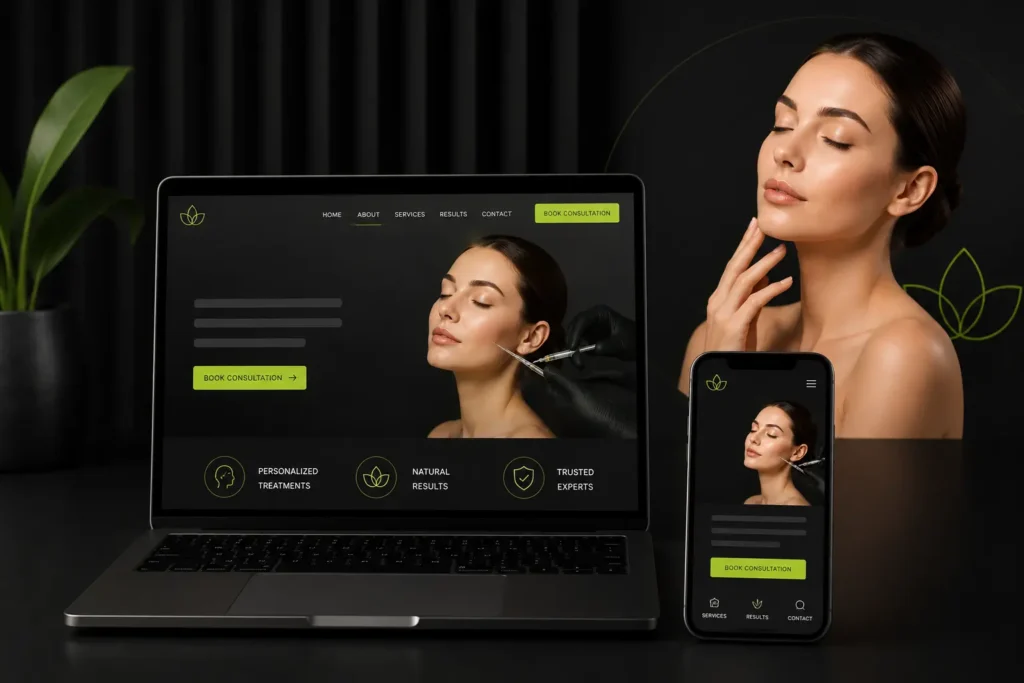
Med spa website design succeeds when a single page answers two questions at once: whether the treatment will work on this specific visitor, and whether your providers are safe to trust. Sites that answer only one lose the booking. Proof, credentials, and a frictionless booking path do both.
Quick answer
- Every visitor asks two questions at once, one aspirational, one cautious. Answer both or lose the booking.
- Real results beat stock photography, but only with documented consent and compliant claims language.
- One page per treatment. That is a ranking decision and a conversion decision at once.
- Any form collecting health history needs a platform that will sign a Business Associate Agreement.
- The hierarchy you approve during design caps what you can rank for later.
Your site gets traffic. The consultation calendar stays soft. Visitors open the gallery, scan the treatment menu, and book somewhere else. This guide covers what actually converts on an aesthetic clinic site, structure, proof, booking, compliance, and search.
Why Med Spa Website Design Follows Different Rules Than Other Healthcare Sites
A primary care website has one job: establish competence and let someone book. An aesthetic practice site runs three at once.
It works as a visual portfolio, because your prospect is buying a result they need to see before believing it. It works as a credibility statement, because injectables and energy-based devices carry real risk. And it works as a booking engine, because most of your traffic arrives on a phone at night and will never call.
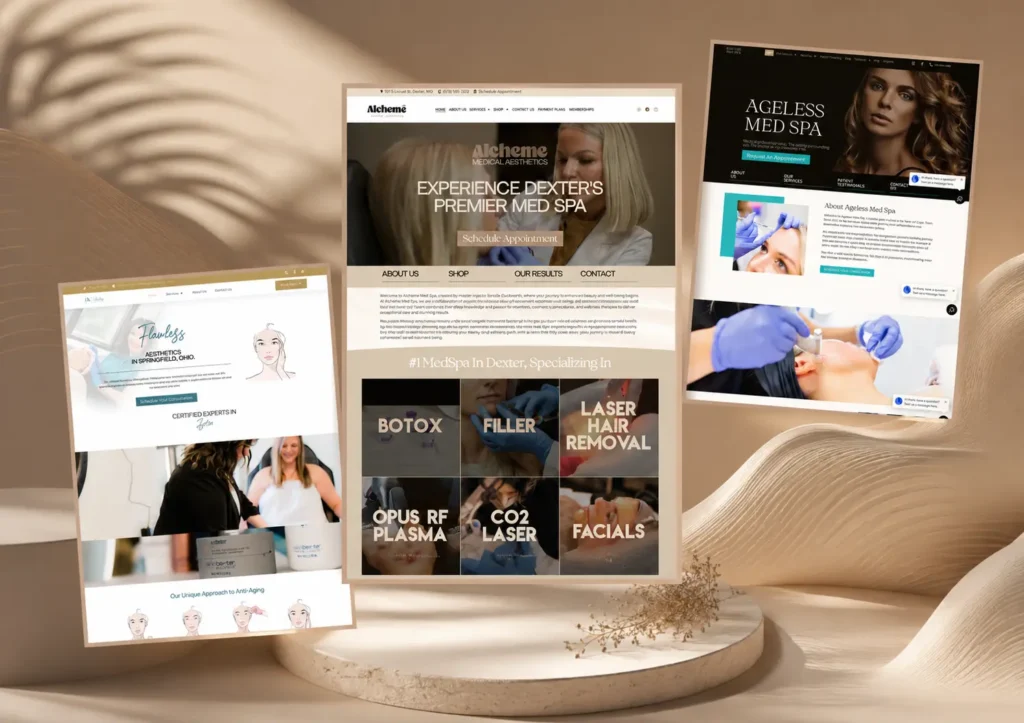
Most templates handle one of the three, which is why so many practices end up with a site that photographs beautifully and books almost nothing. Your competitive set is also wider than it looks, dermatology groups, plastic surgery practices, dental offices that added injectables, and franchise chains with national budgets, all chasing the same treatment searches in your metro. For the broader category view, see how healthcare sites are structured.
The Two-Question Rule: What Every Visitor Is Silently Asking
Every person who lands on your site asks two questions simultaneously, and they pull in opposite directions:
- Will this actually work on me? The aspirational question. They need to see the outcome on someone who looks like them.
- Is this person safe to let near my face? The cautious question. They have seen the bad outcomes online and are scanning for a reason to leave.
We call this the Two-Question Rule, and it is the most useful lens we apply to med spa website design. Almost every conversion problem traces back to a site that answers one question well and the other not at all.
When a site only answers the aspirational question
Moody photography, soft typography, a treatment menu that reads like a spa brochure and no medical director named anywhere. The visitor who wants to be pampered stays. The nervous one, often weighing a larger treatment plan, leaves without a trace.
When a site only answers the cautious question
These sites lead with board certifications, procedure counts, and technical descriptions of mechanism of action. What they rarely show is a result. Nobody books a treatment they cannot picture on themselves, clinical authority establishes safety, but desire is what moves someone from browsing to booking.
Answering both in the same viewport
The fix is structural. Your hero should carry a real result, the credentials of the person who produced it, and one clear path to book — all before any scrolling.
The Homepage Elements That Answer Both Questions
Everything here belongs above or immediately below the fold:
- A real result, not a stock image. A subtle before-and-after does more than any headline.
- The named provider. Headshot, credentials (MD, DO, NP, PA, RN), specialty. Visitors research the injector more carefully than the injectable.
- Aggregate review proof, pulled live rather than typed as static text that ages.
- One primary call to action. “Book a consultation” beats “Contact us” because it names what happens next.
- Treatment navigation grouped by what the patient wants injectables, skin, body, wellness not by clinical category.
- A price signal. A starting range pre-qualifies leads. “Call for pricing” reads as evasive.
- Location and hours, frequently buried, and a direct local ranking signal.
Leave out autoplay video that delays your largest contentful paint, and chat widgets that fire before anyone has read anything. On lead volume specifically, we go deeper on filling a consultation calendar separately.
What the Best-Performing Aesthetic Clinic Websites Have in Common
Across the sites that consistently convert, six patterns repeat:
- Results lead, copy follows. Proof appears before persuasion.
- The provider is a person, not a role, named, photographed, with a stated philosophy.
- Every treatment is a destination, not a paragraph.
- Pricing is visible in some form, figures or ranges, but never silence.
- Booking is embedded where interest happens, on the treatment page.
- Speed is a design constraint, budgeted during design rather than fixed after launch.
Treatment Pages: Why One “Services” Page Costs You Rankings and Bookings
Listing every treatment on a single services page is the most common structural mistake in medspa web design, and it fails twice.
It fails on search, because one page realistically targets one or two queries while patients search treatment by treatment. It fails on conversion, because someone who landed there after searching a specific treatment has to hunt for it. Most will not.
What every treatment page needs to contain
- What the treatment does, in plain language
- What the appointment is actually like, step by step
- When results appear and when they peak
- Downtime and recovery, stated honestly
- Sessions typically required, and price or price range
- Results specific to that treatment, with consent documented
- The provider who performs it
- A booking path on the page itself
How your page hierarchy decides what you can rank for later
The URL structure you approve during design caps your organic visibility for years. Treatments living as anchor links on one page cannot rank individually without a rebuild. As child pages under a treatment parent, each earns its own rankings, internal links, and schema.
Before-and-After Galleries: Proof, Consent, and What Gets Your Ads Rejected
Your gallery is the highest-value element on the site and the one most likely to create a compliance problem. The conversion side is well understood: consistent lighting, angle, and distance across every pair; treatment, session count, and elapsed time captioned on each set; filter tabs by treatment; no retouching beyond exposure correction. Patients who expect an edited result and meet reality become negative reviews.
The compliance side gets far less attention. Results imagery and outcome language are among the most common triggers for ad disapprovals and account restrictions [VERIFY: current FTC guidance on aesthetic advertising claims and Google Ads healthcare and medicines policy].
Gallery captions and treatment claims are advertising copy whether you intended that or not. Words like “permanent,” “guaranteed,” or “eliminates” on a page you later send paid traffic to can cost you the campaign. Build the photo consent workflow before publishing a single pair.
If your gallery is doing more legal work than commercial work, our aesthetic clinic web design team reviews these as part of every build.
Booking Flow: Every Extra Step Is a Lost Consultation
The gap between “I want this” and “I booked this” is where most practices lose revenue.
- Embedded on the treatment page, not a separate booking page, not a phone number.
- Real-time availability. The next open slot creates momentum. “We’ll call you back” creates doubt.
- Provider selection. Removing the choice creates anxiety that prevents booking.
- No account creation for first-timers. Nothing kills a first booking faster than a password.
- Three steps maximum: treatment, time, contact details. The rest happens at intake.
- Immediate confirmation by email and text, with a calendar file attached.
- Click-to-call as a parallel path, not the primary one.
Deposits are worth testing on high-demand slots they reduce no-shows, though they suppress volume slightly. Platform choice matters more than most practices expect, which is why we treat scheduling software for aesthetic practices as its own decision.
HIPAA and Your Intake Forms: Where Most Sites Are Exposed
Any form collecting health history, medications, allergies, or treatment history handles protected health information, which triggers HIPAA obligations regardless of how simple the form looks. You need a platform that will sign a Business Associate Agreement, with encryption in transit and at rest. Free-tier form builders do not meet this bar, and a booking widget storing intake responses without a BAA is exposure your designer may not have flagged.
| Platform | BAA available | Charting / EMR | Multi-location | Best fit |
|---|---|---|---|---|
| Jane App | Yes | Built in | Supported | Single sites and small groups needing clinical notes |
| Zenoti | Yes | Built in | Strong | Multi-location groups and franchises |
| PatientNow | Yes | Built in | Supported | Marketing and EMR in one system |
| Boulevard | Yes | Limited | Supported | Premium front-desk client experience |
| Vagaro | Add-on required | Limited | Supported | Practices already using it for retail |
| Acuity / Calendly | Not standard | None | Basic |
[VERIFY: confirm current BAA availability and terms directly with each vendor — coverage and pricing tiers change, and add-on requirements vary by plan.]
Building the Site So It Can Actually Rank
Design decisions and search decisions are the same decisions. Separating them produces beautiful sites nobody finds.
The schema stack an aesthetic practice needs
Most guidance stops at “add schema.” Here is the actual stack:
- MedicalBusiness or HealthAndBeautyBusiness on the homepage, with
medicalSpecialty, address, geo, and hours - Service on every treatment page, with
providerreferencing your organization entity - Physician or Person on provider bios, with credentials
- FAQPage on treatment pages and guides
- BreadcrumbList sitewide, matching your real hierarchy
- AggregateRating only where reviews are first-party and verifiable
Local SEO decisions made during design
Your Google Business Profile categories, service-area pages, and NAP consistency all depend on structural choices made before a page is written. Location pages need unique providers, reviews, and imagery, a template with the city name swapped creates a duplicate content problem rather than solving a visibility one. See organic visibility for clinics for the full approach.
Getting cited by ChatGPT, Perplexity, and AI Overviews
Generative engines retrieve passages, not pages. Answer each question in the first two sentences beneath its heading, then expand. Keep sections self-contained so a passage lifted out of context still makes sense. Name real entities, devices, certifications, platforms, professional bodies, because those associations make your page retrievable. This is also how you rank for treatment searches in conventional results.
The Consultation Path Audit: 7 Checkpoints From First Click to Booked
This is the audit we run on any med spa website design before recommending changes. Score each checkpoint pass or fail, with no partial credit.
- Three seconds. Can a visitor identify what you do, see one real result, and find the booking path without scrolling?
- Credibility. Is a named provider with credentials visible before the second scroll?
- Findability. Does every treatment have its own indexed page and URL?
- Proof depth. Does each treatment page show results for that treatment, not a general gallery?
- Price signal. Can a visitor form a budget expectation without contacting you?
- Booking friction. Can you book on a phone in under sixty seconds without creating an account?
- Compliance. Does every intake form run through a BAA-covered platform, and does every result image have documented consent?
Fewer than five passes usually means a rebuild costs less than a series of fixes.
Redesigning an Existing Site Without Losing Rankings
Most practices reading this already have a site, and the fear is reasonable, a careless redesign can erase years of visibility overnight.
- Crawl and archive every existing URL before anything changes
- Map every old URL to its closest new equivalent, then 301 redirect
- Never let a redirect chain run more than one hop
- Keep the pages that already rank, improve rather than replace them
- Preserve title tags on ranking pages without a specific reason to change
- Submit the new sitemap and check Search Console coverage daily for two weeks
The most common cause of post-launch traffic loss is not the new design. It is a redirect map assembled after launch instead of before it.
What Med Spa Website Design Costs and How Long It Takes
Published pricing spans a wide range, reflecting genuinely different deliverables. Template builds suit a new practice needing presence more than performance. Semi-custom WordPress builds with booking integration cover most growing practices. Fully custom builds with treatment architecture, schema, and performance engineering suit dense metro markets [VERIFY: current US price ranges by tier — source a 2026 industry pricing survey rather than agency self-reported figures].
Quoted timelines conflict, from two weeks to twelve. Build time is driven by content readiness, not development speed. With finished photography, consented results, and approved copy, a semi-custom site launches in three to four weeks. Starting content from scratch, plan eight to ten.
We build on WordPress by default because it gives practices ownership and SEO control, with custom development where a project requires it. Our healthcare build process is consistent across verticals, with aesthetic-specific work layered on top.
Frequently Asked Questions
What should a med spa website include?
A dedicated page per treatment, a consented before-and-after gallery, named providers with credentials, embedded booking, visible pricing ranges, live review proof, and HIPAA-compliant intake forms. Mobile speed and local SEO structure are prerequisites, not extras.
Do med spa websites need to be HIPAA compliant?
Only the parts collecting protected health information, intake forms asking about medications, allergies, or treatment history. A name, email, and treatment interest generally do not trigger it. The moment a form asks a clinical question, you need a signed BAA.
How long does it take to build a med spa website?
Three to four weeks with photography, consented results, and copy ready. Eight to ten weeks if content starts from scratch. Content readiness sets the timeline, not development speed.
Can I build a med spa website on Wix or Squarespace?
Yes, and for a new solo practice it may be the right first step. The limits show up later: restricted schema control, rigid URL structure, and no clean way to build a treatment page hierarchy.
How often should a med spa website be updated?
Treatment pages whenever pricing, protocols, or devices change. New consented results monthly. Provider bios when staff or credentials change. Check Search Console coverage and Core Web Vitals quarterly.
What makes an aesthetic clinic website different from a regular business website?
Three things: PHI in intake forms, consent and claims rules on results imagery, and content organized by treatment rather than service category. Standard business templates handle none of them.
Getting Your Med Spa Website Reviewed
If your site draws traffic but not consultations, the failure is usually structural and identifiable. Care Digital Experts reviews aesthetic practice websites against the seven checkpoints above and returns a written assessment of what is costing you bookings. Start a conversation with our team when you are ready.