
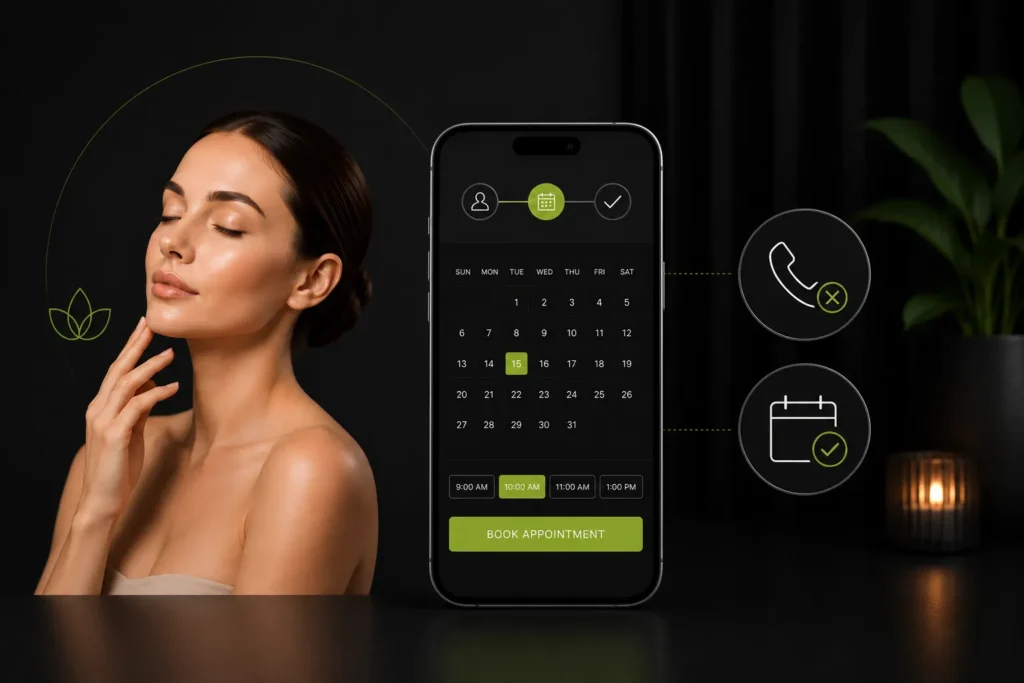
An online booking system for med spas needs three things salon software rarely handles: deposit enforcement on high-value treatments, a consultation-to-treatment path, and intake forms covered by a Business Associate Agreement. Automated reminders do more for your no-show rate than the platform choice itself.
Your best time slots go empty. Patients book, then vanish, and the front desk spends its day chasing confirmations. This article covers what an aesthetic booking system has to do, how deposits actually change behavior, and where the widget belongs on your site.
What “call to schedule” costs an aesthetic practice
Most of your traffic arrives on a phone, outside business hours, from someone who has just decided to do something about a concern they have been thinking about for months. A phone number asks that person to wait until tomorrow.
They will not. They will book with whoever lets them book now. Every hour your practice is closed is an hour your booking system either works alone or loses the appointment.
What aesthetic booking needs that generic scheduling software lacks
Salon and general scheduling tools handle calendars. They tend to ignore the mechanics that protect revenue in aesthetics.
- Variable treatment duration. A consultation, a Botox appointment, and a laser package are not interchangeable blocks.
- Provider-specific calendars. Patients want to choose their injector, and removing that choice suppresses bookings.
- Deposit and card-on-file enforcement on high-ticket treatments.
- Consultation-to-treatment conversion, so the next appointment is booked before the patient leaves.
- Pre-appointment intake with contraindication screening.
- Package and membership mechanics spanning multi-session treatments.
- Waitlist automation that fills a cancellation without a phone call.
If your platform cannot do these, you are running an aesthetic practice on retail software.
Deposits and no-shows
Deposit enforcement is the largest single lever available on no-show rates. A patient who has put money down behaves differently from one who has not.
Configure it deliberately rather than universally. A modest non-refundable deposit on high-demand slots and high-value treatments, converting to the treatment cost on attendance, protects your schedule without deterring first-time consultations. Pair it with a short, visible cancellation policy stated at the point of booking, not buried in a policy page nobody opens.
Expect a small drop in booking volume and a larger gain in attended appointments. Measure both before deciding.
The reminder sequence that does the work
The automation layer separates a low no-show rate from a high one, largely regardless of which platform you run.
- Instant confirmation on booking, with a calendar file attached
- A reminder 48 to 72 hours out, with preparation instructions for the specific treatment
- A short confirmation prompt 24 hours out with a one-tap reschedule link
- A final reminder a few hours before, including parking and arrival detail
- Post-visit aftercare, then a rebooking prompt timed to the treatment interval
Keep every message clinically vague. Reminders travel over unsecured channels, so name the appointment, not the diagnosis or the treatment detail.
Where the booking widget belongs
Not on a separate “Book Now” page. Every click between intent and confirmation loses a share of the people who had it.
Embed booking directly on each treatment page, pre-selected to that treatment. Keep a persistent booking action in the header on mobile. Offer click-to-call as a parallel path for patients who prefer it, never as the primary one. Connect the booking link to your Google Business Profile so patients can schedule straight from Search and Maps. Page placement within the wider layout is covered in where booking sits on the page.
Keep the flow to three steps: treatment, time, contact details. Everything else belongs in intake. Never require account creation for a first booking.
HIPAA at the booking layer
This is where aesthetic practices are most often exposed, and it is rarely flagged during a website build.
A booking widget that only takes a name, contact detail, and appointment slot generally does not handle protected health information. The moment your intake form asks about medications, allergies, medical history, or contraindications, it does and that requires a platform willing to sign a Business Associate Agreement, with encryption in transit and at rest.
General-purpose form builders on standard tiers do not meet this bar. Neither does a booking tool that stores intake responses with a third party you have no agreement with. Split the flow if necessary: unsecured booking for the slot, a covered platform for clinical intake.
The Booking Friction Test
Run it yourself, on your own phone, as a new patient. Time it.
- From a treatment page, can you reach the booking step in one tap?
- Is real availability shown, rather than a request form?
- Can you choose your provider?
- Can you complete it without creating an account?
- Are there three steps or fewer before confirmation?
- Does confirmation arrive by both email and text within a minute?
- Does the whole thing take under sixty seconds?
Anything under five passes is costing you appointments you are already paying to generate. Where those appointments come from in the first place is covered in the inquiries feeding it.
Frequently Asked Questions
Should med spas require deposits on all bookings?
No. Apply them to high-value treatments and peak slots, and keep first-time consultations free to book. Universal deposits suppress the top of your funnel more than they protect your schedule.
What is a reasonable no-show rate for a med spa?
Below eight percent is a workable target for practices running deposits and a full reminder sequence. Consistently above that usually points to a missing automation layer rather than a patient problem.
Does my booking system need to be HIPAA compliant?
Only if it collects health information. Appointment slot and contact details generally do not qualify. Intake asking about medications, allergies, or medical history does, and needs a signed Business Associate Agreement.
Can I use Calendly or Acuity for a med spa?
For consultation booking where no clinical questions are asked, often yes. For intake that collects health history, verify BAA coverage on your specific plan before relying on it.
Map Your Booking Flow
If your calendar has gaps while your ad spend stays flat, the booking flow is usually the reason. Care Digital Experts runs the friction test above and rebuilds the path where it breaks. Map your booking flow whenever you are ready.