
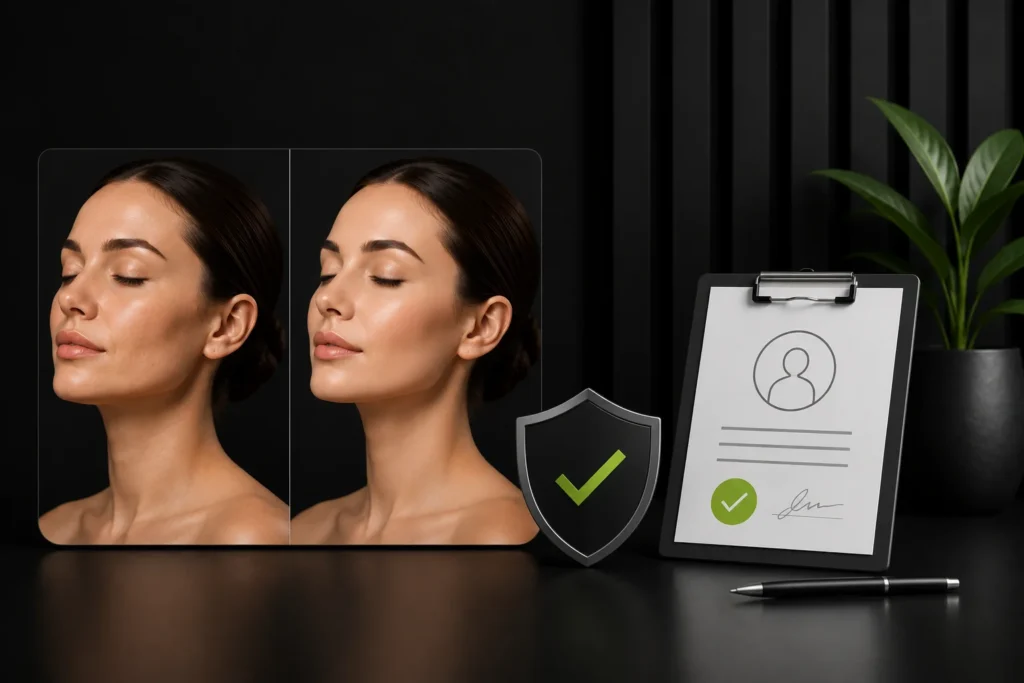
A before and after photo gallery requires written marketing authorization that is separate from treatment consent. Clinical photography and marketing photography are legally distinct uses, and a patient must be able to agree to one without agreeing to the other.
Your gallery is the highest-converting element on your site. It is also the element most likely to produce a complaint, a takedown, or a licensing problem. This article covers the consent standard, what counts as identifiable, and how to publish results that hold up.
Why a treatment consent form does not cover marketing use
This is the single most common mistake in aesthetic practice marketing. A general consent signed at intake documents agreement to be treated and photographed clinically. It does not authorize public disclosure.

Marketing use puts protected health information in front of the public, which requires separate written authorization. Bundling the two into one blanket form may not satisfy the requirement, and conditioning treatment on marketing consent is not permitted. Patients must be free to say yes to clinical photography and no to Instagram.
What a compliant authorization must state
Written, signed, and specific. Verbal agreement is not sufficient.
- Who may use the images, your practice, named providers, and any marketing vendors
- Exactly what was photographed, including body areas and conditions captured
- Where the images may appear, listed individually: website, Instagram, Facebook, paid ads, print, presentations
- How they may be used, promotional, educational, internal training
- An expiration date
- The patient’s right to revoke, and what revocation does and does not undo
Authorization should meet the standard set out in 45 CFR §164.508 and be retained for at least six years. A website release does not automatically permit social posting, if the form does not list the channel, you do not have permission for it.
When to ask for marketing consent
Not immediately before the procedure. A patient on the treatment table may feel obligated to agree, and consent given under that pressure is weak both ethically and practically.
The follow-up period is better. Once results have settled and the patient is pleased, the ask is honest and the yes is meaningful. Build it into your standard follow-up rather than treating it as an occasional request, and record the answer in the patient’s file either way.
What counts as identifiable
Broader than most practices assume. It is not limited to full-face images.
- Tattoos, birthmarks, and distinctive scarring
- Jewelry, including rings and distinctive piercings
- Background details that identify a location or person
- Filenames and image metadata containing patient names or dates
- A cropped image paired with a caption naming the treatment and city
Strip metadata before upload. Rename files. A photo is identifiable if the combination of elements makes the person recognizable, not only if the face is visible.
Photography standards that make results credible
Compliance keeps you out of trouble. Consistency is what makes the gallery convert.
- Identical lighting, angle, distance, and background across every pair
- Neutral expression in both frames, since a smile changes facial architecture
- No filters and no retouching beyond exposure correction
- Caption each set with treatment, number of sessions, and time elapsed
- Show a range of ages, skin types, and concerns rather than one ideal patient
- Include the provider who performed the treatment
Patients who arrive expecting an edited result and meet reality become negative reviews. Honest photography is a retention strategy, not just a legal one.
Where galleries belong on the site
A single gallery page collects traffic and converts poorly. Results perform best where the decision is being made.
Place treatment-specific results on the relevant treatment page, above the detailed description. Keep a filterable master gallery as a secondary destination for browsers. Optimize every image for weight, since galleries are the most common cause of slow aesthetic sites, and add descriptive alt text naming the treatment. Gallery placement within the wider page structure is covered in where results sit on the page.
State rules and FTC claims
Federal privacy law is the floor, not the ceiling. Several states impose additional requirements on patient imagery and on how aesthetic services are advertised, including rules on identifying the supervising physician. Some states mandate specific consent documentation.
Separately, results claims are advertising. Guarantees of outcomes and comparative claims without evidence are common prohibitions, and images must fairly represent typical results under consistent conditions [VERIFY: confirm current FTC guidance and your own state board advertising rules]. Add a visible disclosure near the gallery noting that results vary and that patients consented to publication.
The Gallery Publishing Checklist
Run every image through this before it goes live. One failure means it does not publish.
- Separate written marketing authorization on file, signed and dated
- The specific channel you are publishing to is named in that authorization
- Authorization has not expired and has not been revoked
- Metadata stripped, file renamed, no identifying detail visible
- Before and after captured under matching conditions
- Caption states treatment, sessions, and elapsed time
- No guarantee language anywhere near the image
- Consent and variation disclosure visible on the page
Store the checklist result alongside the authorization. If a complaint arrives, the documentation is the defense.
Frequently Asked Questions
Do I need consent if the face is not visible?
Usually yes. Identifiability includes tattoos, jewelry, distinctive scarring, and background detail. If any combination of elements makes the patient recognizable, the image is protected and requires authorization.
Can a patient withdraw consent after publication?
Yes, and your authorization should explain what revocation does. You must remove the image from channels you control. Content already shared or reposted elsewhere may be beyond your reach, which is worth stating plainly.
Can I use manufacturer-supplied before and after images?
Only within the license terms, and only if labeled clearly as manufacturer imagery rather than your own results. Presenting supplied photos as your work is a misrepresentation and patients frequently notice.
How long should I keep photo authorizations?
At least six years, aligned with the general HIPAA documentation standard. Store them where they can be retrieved by patient and by image, not filed loosely.
Have Your Gallery Reviewed
If your gallery was built before your consent process was, it is worth a proper look. Care Digital Experts audits aesthetic galleries for both conversion structure and documentation gaps. Request a gallery review at any point.